Criminal Justice
33rd Session of the Commission on Crime Prevention and Criminal Justice
Statement by the Director-General, Ms Jan Beagle

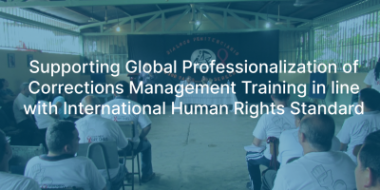
New International Advisory Group Steers Global Corrections Curricula, with Support from IDLO and INL
At any given time in the world, 11.5 million people spend their days behind bars, often pending trial and in overcrowded cells. Prisons operating above their occupancy limits are difficult to manage. In many countries, this translates into corrections systems where international human rights standards and respect for the rule of law are rarely implemented.

IDLO Director-General, Jan Beagle's Statement at the Special Event on Equal Access to Justice for All - UN Congress on Crime Prevention and Criminal Justice
Statement by the Director-General, Jan Beagle at the Special Event on Equal Access to Justice for All - 14th UN Congress on Crime Prevention and Criminal Justice
9 March, 2021
Kyoto, Japan
Excellencies,
Distinguished Delegates,
Colleagues and Friends,
IDLO Director-General Jan Beagle's Statement at the Special Event on Equal Access to Justice for All - UN Congress on Crime Prevention and Criminal Justice
IDLO Director-General Jan Beagle's statement to the High-level Segment of the Congress on Crime Prevention and Criminal Justice
Statement by the Director-General, Jan Beagle at the 14th UN Congress on Crime Prevention and Criminal Justice
8 March, 2021
Kyoto, Japan
Mr. President,
Executive Director Waly,
Excellencies,
Colleagues and Friends,
IDLO Director-General Jan Beagle's statement to the High-level Segment of the Congress on Crime Prevention and Criminal Justice
Statement by IDLO at the Nineteenth Session of the Assembly of State Parties to the Rome Statute
Nineteenth Session of the Assembly of State Parties to the Rome Statute
Mr. President of the Assembly,
Mr. President of the International Criminal Court,
Madam Prosecutor of the ICC,
Mr. Registrar,
Honorable Ministers,
Excellencies, Distinguished Delegates, Esteemed Representatives of the Civil Society,
Honduras Court admits petition to protect prisoners from COVID-19
The COVID-19 pandemic is affecting every aspect of society, but vulnerable groups who were already marginalized will likely bear the greatest burden.

Alumni Voice from the Philippines
In 1998, while working as a Court Attorney in the Court of Appeals of the Philippines, Rowena Nieves A. Tan, had the opportunity to come to Rome to attend the “Development Lawyers Course”, a flagship 12-week course organized by IDLO to provide practical training on a range of basic lawyering skills, as well as more specialized legal topics.

Pages
Key Initiatives
-
Despite reform efforts undertaken by the Government of Ukraine after the Maidan Revolution in 2014, Ukrainian citizens continue to regard criminal justice stakeholders with deep distrust. In 2019, the presidential and snap parliamentary elections resulted in a shift of the political environment, creating an opportunity to meaningfully advance anti-corruption reforms. -
The failure of criminal justice systems in the Sahel to deliver better quality justice can be linked to a series of interconnected factors, such as: the overwhelming lack of human, material and financial capacity; corruption and weak internal control mechanisms; and limitations on civil society to ensure respect for human rights. -
As part of IDLO’s continuous commitment to accountability and results-based management, IDLO is pleased to share this Mid-Term Evaluation Brief for the project, “Strengthening the Criminal Justice Chain in the North of Mali (SCJC)”. The evaluation has been conducted by independent evaluation experts, supervised by IDLO’s Evaluation Unit. -
Español | English: Mexico has made significant efforts to modernize its criminal justice system, specifically regarding public security and strengthening the rule of law. The current justice system, which entered into force in 2016, is based on the presumption of innocence and includes police professionalization as a public policy.
-
Somalia’s economy remains heavily dependent on remittances from the Somali diaspora, which the International Monetary Fund estimates account for approximately 23 per cent of Somalia’s GDP. However, examining and supervising such transactions is difficult as Somalia’s formal banking sector is nascent and underdeveloped. Concerns over the lack of a basic, functioning, regulated financial sector and weak financial regulation and oversight, including customer identification measures, have eroded international confidence in Somalia’s financial firms.
Latest Activity
|
Policy Statements
|