Organisation Internationale de Droit du Développement
Accueil > Taxonomy > Term

Building Judicial Capacity

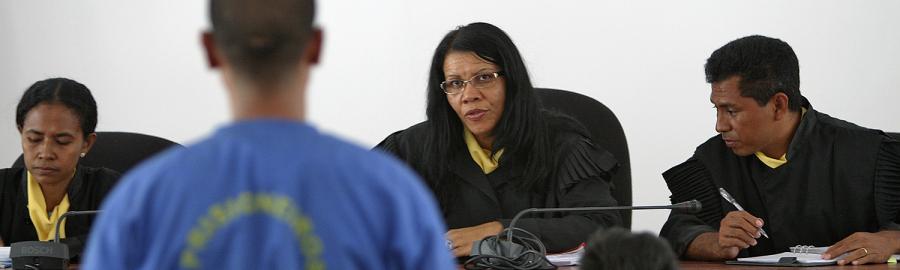
Efficient, equitable and accessible justice systems are the lifeblood of the rule of law. For many years, building judicial capacity in the developing world was IDLO's sole area of intervention.

Today, while our mission and expertise has greatly expanded, we remain faithful to that early purpose. Building capacity in the judiciary is still the bulk of what we do, and what we are most recognized for. We do this in a variety of legal systems and traditions, working with local and international partners, with a strong emphasis on transition societies.

In the words of Kyrgyz Supreme Court Chair and IDLO interlocutor Feruza Z. Djumasheva, "Without successful judicial reforms, there will be no economic or social reform."

Judicial Capacity Building on the New Armenian Code of Civil Procedure

In April 2018, the Republic of Armenia adopted a new version of the Civil Procedure Code with the aim to expedite cases and increase the efficiency of civil courts. As in most transition countries, implementation of the law by courts and officials is weak and uneven. The judiciary needs to become familiarized with the new Civil Procedure Code and its application within a limited timeframe. Hence, it is critical that judges have a firm grasp of the newly adopted rules, especially related to commercial disputes.


Rule of law fund: programmatic framework

The Programmatic Framework for the Indonesia-Netherlands Rule of Law Fund builds on Indonesian development plans and continues the efforts of the Embassy of the Kingdom of the Netherlands in Jakarta to support the consolidation of the rule of law and reform agenda. The primary objective of the Rule of Law Fund is to support the development of effective, accountable and inclusive justice sector institutions, ensuring equal access to justice in Indonesia.

Strengthening the capacity to investigate human rights violations in Yemen

Yemen, one of the poorest countries in the Arab world, has been devastated by armed conflict since September 2014. The conflict has received limited international coverage and human rights violations and violations under international humanitarian law suffered by the civilian population have been grossly underreported. All parties to the conflict have been linked to serious violations of international law, with inadequate accountability mechanisms in place to ensure justice for victims.

Jordan - Strengthening Capacity of National Partners in Economic Laws

With support from the Kuwait Fund for Arab Economic Development, IDLO collaborated with the Judiciary of Jordan from 2019-2020 to enhance the role of economic courts as key drivers of economic growth.

This effort included a comprehensive needs assessment of economic courts, conducted in partnership with legal professionals and business community representatives. The assessment findings informed the development of Jordan’s National Justice Sector Strategy.

Strengthening Institutions to Improve Access to Justice for SGBV Survivors in Liberia

In the post-conflict transition, significant steps have been taken to combat sexual and gender-based violence (SGBV) in Liberia. The Government of Liberia established a policy and legal framework that includes the Rape Law (2006), a National Gender Policy (2017), and a National Plan of Action for the Prevention and Management of Gender-Based Violence in Liberia. However, in 2017, over 1100 SGBV cases have been reported in Montserrado County alone, representing only a small proportion of the violations that occur. Furthermore, the number of cases that have progressed to court remains low.

Pages

Key Initiatives

Souscrire à RSS - Building Judicial Capacity