Reflections on IDLO’s 2016 work in the EECA region
On a recent trip to a Central Asian preliminary detention center, the custodians proudly showed us the new ventilation system to prevent from spread of TB – a cut-in window directly across the door.


Among the least developed economies in Asia, Kyrgyzstan has been hampered by weak state institutions and a security environment that is not immune to ethnic tensions and social unrest. The judiciary, which had been hindered by political influence and corruption, is now undergoing a process of modernization, supported by IDLO.
On a recent trip to a Central Asian preliminary detention center, the custodians proudly showed us the new ventilation system to prevent from spread of TB – a cut-in window directly across the door.
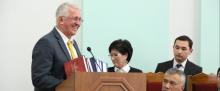
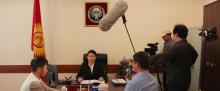
The Kyrgyz judiciary is not favorably viewed by the public and, at the same time, the public is not well-informed about the functions and duties of the courts. To assist the judiciary in strengthening communications with the public, IDLO under the USAID-IDLO Judicial Strengthening Program, has been providing assistance in the development of a communications strategy for the judiciary and training of new press secretaries of local courts taking up their duties for the first time in the history of the Kyrgyz Republic.
IDLO has been working with the Kyrgyz Judiciary to support the establishment of a functional, credible and transparent legal system, since the adoption of the 2010 Constitution. Despite many positive developments, the rule of law sector has faced a number of problems – chief among them inadequate financing, which risks undermining judicial independence and makes access to justice a challenge, as well as transparency and accountability.
Funding and spending patterns of the General Procuracy of the Kyrgyz Republic (GP) have remained relatively invariable since Kyrgyzstan became an independent state in 1991. Stagnant funding has had negative implications for the GP, and the Prosecutors’ Training Center (PTC) requires support to train and retrain prosecutors in accordance with changing Kyrgyz legislation and international human rights standards. Additionally, gender inequalities within the GP remain a significant challenge.
In Kyrgyzstan, research indicates that the population not only distrusts the court system but also knows very little about his or her own legal rights or the role of the judiciary.

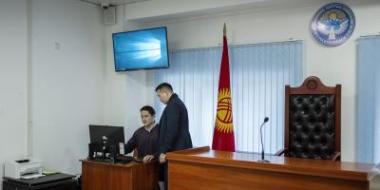
With the support of USAID and IDLO as part of the Judicial Strengthening Program in Kyrgyzstan, students participated in a mock hearing as part of their judicial training and coursework. This course helps prepare future lawyers by exercising their practical skills in the courtroom. These students’ successors, who will take part in similar courses, will be able to view their work soon when videos of the mock trials are finalized and edited as teaching tools.
Since Kyrgyzstan's independence in 1991, the country's Judiciary has suffered from financial shortfalls. This resulted in a lack of capacity to improve the quality of decision making and regularly update the level of judges' knowledge of current legislation. One particular area of importance for judicial training is commercial law, crucial for Kyrgyzstan in seeking to reduce corruption and spur economic development.
As in many transition countries, the Kyrgyz judicial system suffers from a low rate of court decision enforcement, with lengthy delays common, and a rate of successful enforcement estimated at only 30%. Moreover, significant challenges exist in relation to prevention and punishment of debtors who hide assets or evade court orders, and a lack of a database where bailiffs can easily obtain necessary information on debtors.
Languages: English, Pусский
by Fred Huston, IDLO Country Director

A herd of cows belonging to Bakyt Azizov has trampled over land belonging to Aybek Isaev. As a result, Mr. Isaev’s future oats harvest has been partly compromised. Mr. Isaev is now claiming from Mr. Azizov 85,600 Kyrgyzstani som (US$ 1,340) in compensation, divided as follows: direct damage – 7,100 som; profit lost – 48,500 som; moral damages – 25,000 som; and lawyer’s fees – 5,000 som.